The day sheet is the most-read document on any tour. Here is what belongs on it, what does not, a copy-paste template, and the habits that keep every version current.
Updated September 4, 20268 minute readIncludes a copy-paste template
What a day sheet is, and who it is really for
A day sheet answers one question for everyone on the tour: what is happening today? One page. Times, places, names, numbers. It gets read on a phone in a bunk, taped to a production office door, and glanced at forty times between load-in and bus call.
That reading pattern is the design constraint. The day sheet is not the advance, and it is not an archive. It is the interface between all the work you did in the advance and the eighteen people who need five facts each. Anything that does not help someone make a decision today is clutter.
Rule of thumb
If the crew has to scroll, zoom, or ask a follow-up question, the day sheet is not done. Aim for one page that a rigger can read in the dark at 7 a.m. with one eye open.
Anatomy of a day sheet crews actually read
Order matters more than people think. Keep the same structure every single day so eyes land on the right block by habit:
1
The header: day, date, city, venue
Big and unambiguous, including the show number if you track one. On a 30-date run the days blur; the header is what stops someone from prepping for the wrong city.
Day 14 of 32 | Thursday, Oct 15 | Nashville, TN | Ryman Auditorium
2
The schedule
Every timed event in one column, in local time, from first departure to bus call. This is the block people read most, so it goes high on the page.
09:00 Load-in / local crew call
12:00 Lunch (venue catering)
15:00 Soundcheck: headliner
16:30 Soundcheck: support
19:00 Doors
20:00 Support set
21:15 Headliner set
23:00 Curfew | 00:00 Bus call
3
Addresses that match reality
Venue address for GPS, dock address if different, hotel address, and tonight's drive. The difference between the front door and the dock can be three blocks and a one-way street.
4
Contacts for today only
Production manager, promoter rep, runner, box office. Names and cells for the people someone might actually need to call today, not the whole tour directory.
5
Travel and lodging
Hotel name, check-in details, rooming reference, and any flights or ground moves happening today with confirmation numbers.
6
The notes that prevent questions
Wifi and password, showers and laundry, catering plan, parking notes, credential pickup, weather if it changes the day. The best notes block reads like answers to yesterday's questions.
Wifi: RYMAN-PROD / hattie1892 | Showers: 4 in basement
Laundry: hotel, 2 blocks | Dinner: buyout $30 | No haze per venue
7
Tomorrow, in one line
Where you wake up, first call time, and the drive. Enough for everyone to set an alarm without asking.
The template
Copy this into your document of choice and keep the structure identical every day. Delete what a given day does not need, but do not reorder it.
Day Sheet TemplateFrom "The Tour Day Sheet" · advancewithme.com/guides/day-sheet-template
Day sheet template
=== [ARTIST] DAY SHEET ===
Day [X] of [Y] | [Day], [Date] | [City, State] | [Venue]

--- SCHEDULE (all times local) ---
[00:00]  Hotel departure / lobby call
[00:00]  Load-in / local crew call
[00:00]  Lunch
[00:00]  Soundcheck: [artist]
[00:00]  Soundcheck: [support]
[00:00]  Dinner
[00:00]  Doors
[00:00]  [Support] set ([length])
[00:00]  [Artist] set ([length])
[00:00]  Curfew
[00:00]  Bus call

--- ADDRESSES ---
Venue:  [address]
Dock:   [address or "same as venue"]
Hotel:  [name, address]
Tonight's drive: [X hrs to next city]

--- CONTACTS ---
Venue PM:      [name, cell]
Promoter rep:  [name, cell]
Runner:        [name, cell]
Box office:    [name, cell]
TM (that's me): [name, cell]

--- TRAVEL & LODGING ---
Hotel: [name] | Check-in: [time] | Conf #: [number]
Rooming: [reference or "see rooming list"]
Flights/ground today: [details or "none"]

--- NOTES ---
Wifi: [network / password]
Showers: [where] | Laundry: [plan]
Catering: [plan] | Parking: [notes]
Credentials: [pickup details]
[Anything unusual about today]

--- TOMORROW ---
[City] | First call: [time] | Drive: [X hrs]
Free from Advance with Me · advancewithme.com
Five rules that keep the day sheet trusted
One page, every day. The moment a day sheet needs scrolling, it stops being read top to bottom and starts being skimmed. Cut before you shrink the font.
Local times only. Time zone math at 2 a.m. causes missed lobby calls. If a flight crosses zones, write both times and label them.
Same order, same place, every day. Crews build muscle memory. Reordering blocks to fit content breaks the one habit that makes the sheet fast to use.
One source of truth. When details change, update the original and tell people what changed. Two versions in circulation is worse than none, because someone will trust the wrong one.
Written from the advance, not from memory. Every fact on the sheet should trace back to something the venue confirmed. If you are not sure it was confirmed, it is a question, not a note. Our guide to advancing a show covers how to get all of it confirmed.
How Advance with Me builds day sheets
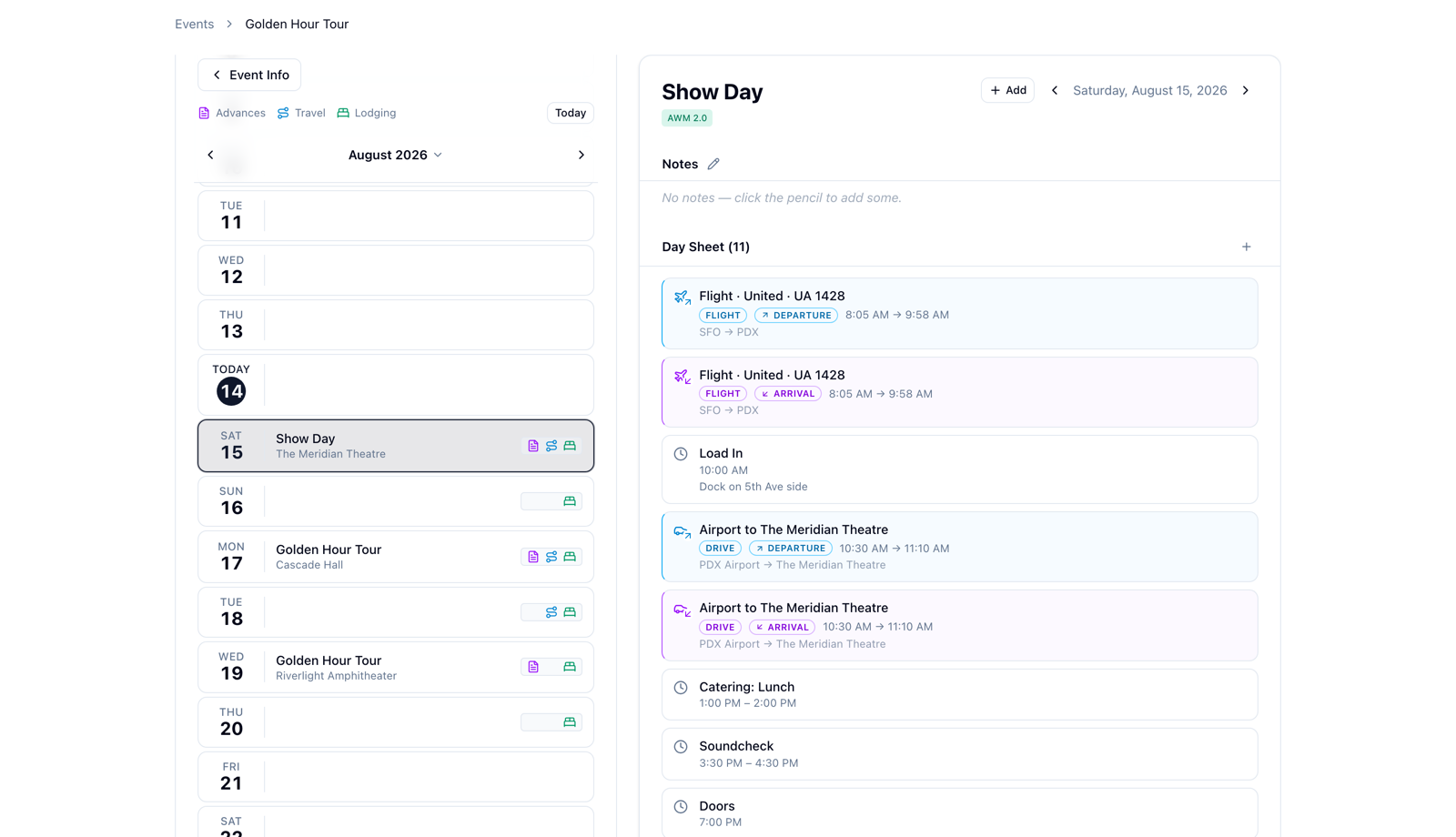
Manual day sheets fail in one predictable way: they are copies. Every time the schedule shifts or a hotel changes, someone has to remember to re-copy the truth into the sheet. Advance with Me removes the copy step. Daysheets are generated from the same calendar the advance, travel, and lodging already live in, so a change made once shows up everywhere: on the web, in the PDF export, and in the AWM Go iPhone app the crew carries, which keeps working offline inside buildings with no signal.
A daysheet in Advance with Me: show items, travel, and lodging merged into one timeline, exportable as a clean PDF.
Frequently asked questions
What is the difference between a day sheet and an itinerary?
The itinerary is the whole run at a glance: dates, cities, venues, and travel. The day sheet is one day in operational detail. Crews plan the week with the itinerary and run the day with the day sheet.
Who makes the day sheet?
Usually the tour manager, since the sheet summarizes what the advance confirmed. On bigger tours a production coordinator may own it. Either way it should be built from the advance, not reconstructed from memory.
When should it go out?
The night before at the latest. Posting after the show lets the bus read tomorrow on the drive. If something changes after it goes out, push the update through the same channel and say exactly what changed.
Day sheet, daysheet, or day-of schedule?
Same document, different house styles. You will also hear "run sheet" or "show day schedule." Whatever the name, the job is identical: one page that answers what is happening today.
Skip the copy step
Day sheets that update themselves when the advance changes.
Build the advance once and let daysheets, labor calls, and PDFs stay in sync. Crew see their day in AWM Go, even offline.